.svg)



Customer Experience
Elevating CX from booking to boarding this Ramadan & Eid: A guide for travel brands
When families plan their Eid trips, does your brand’s name even cross their minds—or are you already irrelevant?
When families plan their Eid trips, does your brand’s name even cross their minds—or are you already irrelevant?


The following blog post incorporates insights derived in part from data gathered through Lucidya’s AI-powered Monitor solution.
When families plan their Eid trips, does your brand’s name even cross their minds—or are you already irrelevant?
Ramadan has a way of pulling back the curtain on businesses. During this period, the little shortcomings in your customer experience that might’ve been overlooked during less busy months are suddenly impossible to ignore. That’s because, for many, Ramadan is a shift in consciousness. Customers tend to operate in a heightened emotional state during the Holy Month. Their daily routines change and their tolerance for service friction decreases significantly. What might be a minor inconvenience any other time becomes magnified through the lens of spiritual and physical demands.
This blog post is an invitation to rethink how you show up to your customers, not as a travel business, but as a partner in their observance. It’s a chance to move beyond transactional interactions and craft experiences that honor their spiritual focus, ease their unique challenges, and amplify their joy as they prepare for Eid. By doing so, you’ll not only make their season special but also give them a reason to keep coming back for more.
Customers want to sense that you understand how important Ramadan is to them. They expect convenience, respect, and care in meeting their seasonal needs. When you don’t deliver on these expectations, they will notice, remember, and are less likely to return the following year to enjoy your services. Worst of all, they become active faultfinders and critics who steer potential customers away from your brand.
In response to this phenomenon, market leaders have recognized the importance of tailoring customer experience strategies to meet customers where they are in their buying journey. It is noteworthy that 72% of GCC consumers demonstrate preference to trusted brands during Ramadan, a choice that signifies more than mere brand loyalty; it is an indication of their inclination towards businesses that exhibit a genuine understanding of their Ramadan spirit.
For businesses operating within the travel sector, it is imperative to recognize the potential repercussions of failing to extend the requisite support during this important month. Ask yourself: Why risk being remembered for the wrong reasons during a time that matters so deeply to your customers?
The intersection of high-season travel dynamics and Ramadan festivities creates a perfect storm in capacity management, resulting in significant operational pressures across the travel value chain.
This month creates what might be the most predictable yet underoptimized market opportunity in the global economy. We’re looking at a massive 2B+ consumer base that’s observing the season. When was the last time you had a guaranteed annual opportunity to connect with 25% of the global population? It’s a transformation lever waiting to be pulled. Yet most players continue to treat this as a mere operational challenge.
This misalignment between opportunity and approach creates a clear opening for organizations ready to think differently.
With half of those celebrating expected to travel during Eid, the arrival of Ramadan prompts an unprecedented acceleration in travel activity. The spike in travel planning during Ramadan is usually driven by a mix of spiritual, familial, and cultural motivations. Umrah remains central, with growing capacity enabling more pilgrims to visit Makkah. Business travel persists, while family reunions take priority as loved ones return home for Iftar and Eid. Many also seek to experience Ramadan traditions abroad, drawn by unique cultural practices and the pull of Eid Al-Fitr celebrations.
During this period, booking systems are under considerable pressure, support teams have little choice but to work faster, and customers, too, are not shy about pointing out any shortcomings they perceive in a service. The complaints tend to increase, response times become slower, and regardless of the extent of preparation, the sense of being perpetually out of step persists.
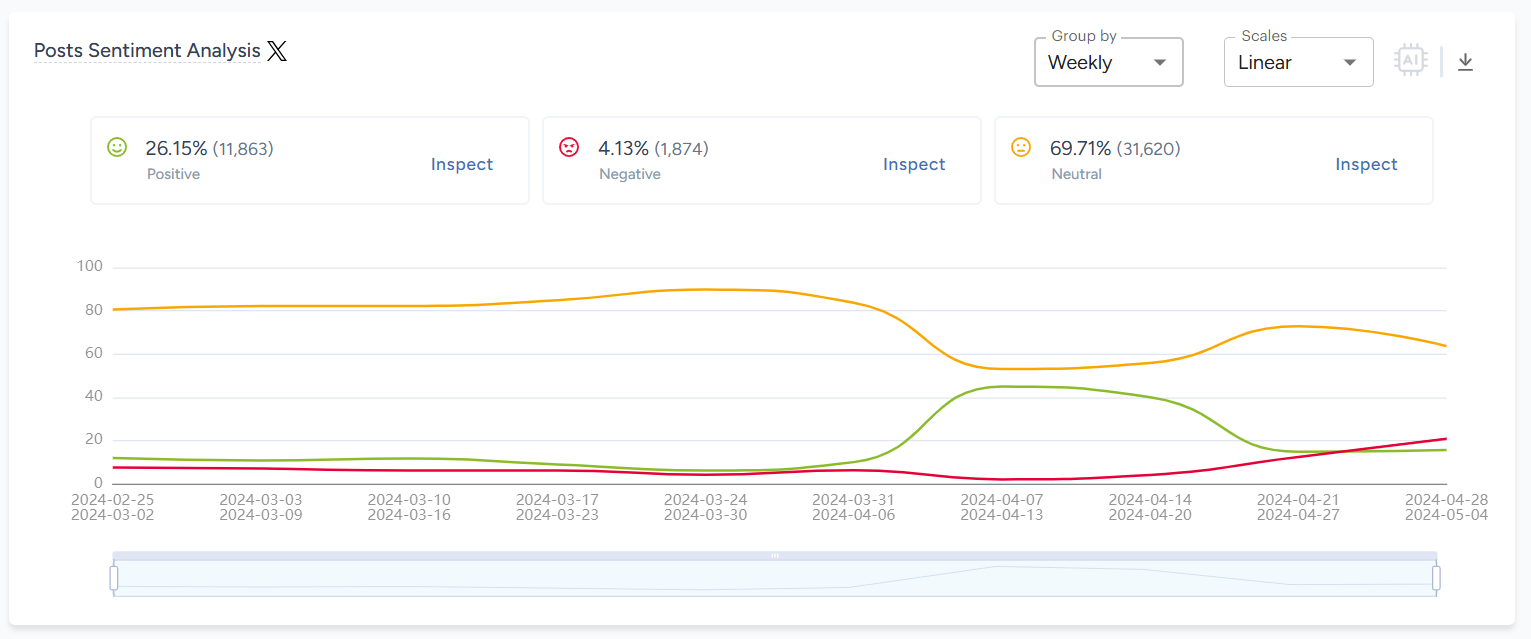
Fig 1.0 – Weekly travel customer sentiment analysis from X (March-April 2024)*
To better understand the nature of season-specific complications experienced by travel businesses, we leveraged our advanced AI-powered Monitor solution to conduct an analysis of traveler sentiment throughout Ramadan 2024. We were able to capture nuanced emotional shifts across the customer journey.
These patterns illuminate the travel industry-related CX challenges and opportunities we’ll now explore, along with strategic solutions to transform Ramadan service moments into lasting loyalty.
A 116% increase in Ramadan airline ticket orders signals strong Eid holiday travel demand. Although the influx of travelers at airports typically drives revenue for the travel ecosystem, unprepared airlines, agencies, and airports encounter resource constraints, overbooked flights, and overwhelmed staff, ultimately compromising their ability to deliver personalized travel journeys to their passengers.
A common mistake among these struggling businesses is the underestimation of the traveler’s journey, which begins long before a ticket is booked. The phases of curiosity, planning, and expectation-building are ripe for influence, yet many brands treat Ramadan as a transactional sprint rather than a year-round engagement cycle. This narrow focus leads to substandard customer experience during periods of high-demand, with measurable consequences. Generally, the limited availability of services and inflexible pricing push travelers to competitors, while missed upsell opportunities, such as family-friendly packages or priority services, result in revenue being left untapped.
It is therefore the duty of travel businesses to address these customer experience (CX) pain points if they are to avoid the risk of short-term revenue loss and long-term loyalty erosion, as customers are likely to gravitate toward brands that better understand and cater to their needs during this sacred time.
Want to fix these CX missteps? Here are some examples of what you can do:
In the high season period, the volume of customer inquiries received via multiple channels invariably increases, leading to long wait times and abandoned bookings. With more customers comes more inquiries concerning bookings, reservations, and special requests. Call centers and chatbots buckle under the weight, and emails accumulate. Slow responses from travel service providers give customers the impression that they have been disregarded. This is especially problematic during a time of intensified expectations for smooth and thoughtful services. Faced with extended wait times for booking confirmations or special arrangements, they often abandon their plans and switch to competitors.
In such circumstances where service levels are found to be deteriorating, teams may resort to the offer of refunds, upgrades, and other costly concessions in an attempt to appease those frustrated customers. This reactive approach, however, not only strains operational resources but also fails to address the root cause of overwhelmed service channels. This creates a persistent gap between customer expectations for seamless, culturally aware service and the actual experience delivered during high-demand periods.
Want to fix these CX missteps? Here are some examples of what you can do:
A considerable number of travel businesses talk the talk but don’t walk the walk. Despite their public pledges to provide “authentic experiences” and “Eid extravaganzas,” they end up delivering uninspired service that falls short of their promises. For instance, some airlines may advertise a “special Ramadan journey” with halal gourmet meals and stress-free travel arrangements, but upon boarding, passengers are served reheated meals and face chaotic schedules. Similarly, several travel agencies claim to offer an “Eid travel program to remember,” but the reality is overcrowded itineraries and zero festive ambiance.
Overpromising and underdelivering is a recipe for disaster, regardless of the season. According to a report by Zendesk, 90% of customers are willing to pay more for personalized experiences. However, only 30% of travel and hospitality agents feel equipped to meet those expectations. When businesses fail to meet the bar they’ve set, the backlash is immediate and merciless. In markets like Saudi Arabia, where travelers actively share their experiences through word-of-mouth, a single letdown can spiral into a PR nightmare, bearing both financial and reputational consequences. It is evident that travel businesses that are unable to align their promotional campaigns with the quality of their services are setting themselves up for a crash landing.
Want to fix these CX missteps? Here are some examples of what you can do:
The challenges faced by travel brands during Ramadan are not limited to operational hurdles. They stem from a deeper issue: a lack of clarity. When brands fail to truly understand their customers’ needs, preferences, and emotional drivers, they risk delivering experiences that feel transactional rather than transformative. In a season defined by heightened expectations and emotional investment, these missteps can damage customer trust and loyalty, leaving brands vulnerable to competitors who see their customer base more clearly.
Thinking clearly changes everything. For travel brands, it means leveraging customer journey mapping to anticipate Eid travel surges before they overwhelm, offering hyper-personalized experiences that feel thoughtful and well-planned.
At Lucidya, we believe clarity is the foundation of exceptional customer experiences. Through our AI-powered CXM platform, we enable travel brands to move beyond assumptions, using predictive analytics and actionable, data-driven insights to strategize and act with precision. By turning concrete customer and market data into timely action, you gain the ability to convert Ramadan’s unique challenges into opportunities for meaningful connection, delightful service, and market differentiation.
What if your brand was the first name that came to mind when families planned their Eid trips? Find out how Lucidya can help you transform your Ramadan strategy. Explore our solutions or contact us for a demo and see the difference clarity can make.


.svg)
Lucidya is the leading AI-native platform for customer experience intelligence in the Arab World. With its unique AI and NLU capabilities, this CXM platform is designed to give brands the power to deliver game-changing customer experiences anywhere in the region.
Lucidya connects all your customer-facing channels — social, media, surveys, and support — into one intelligent system. It turns raw data into actionable insights so your teams can monitor sentiment,tailor messaging, protect reputation, boost satisfaction, all in real time.
Unlike generic AI tools, Lucidya’s AI is developed fully in-house and trained on Arabic — including 15 dialects — ensuring unmatched accuracy for sentiment and tone detection in the MENA region.
Yes. Lucidya complies with Saudi PDPL, GDPR, and SOC2 standards. Data is encrypted, securely stored, and can be hosted regionally to meet compliance needs.
Lucidya is the leading platform for customer experience management in the Arab World. With unique AI and NLU capabilities, this CXM platform is designed to give brands the power to deliver game-changing customer experiences anywhere in the region.
Lucidya is the leading platform for customer experience management in the Arab World. With unique AI and NLU capabilities, this CXM platform is designed to give brands the power to deliver game-changing customer experiences anywhere in the region.
Lucidya is the leading platform for customer experience management in the Arab World. With unique AI and NLU capabilities, this CXM platform is designed to give brands the power to deliver game-changing customer experiences anywhere in the region.
Lucidya is the leading platform for customer experience management in the Arab World. With unique AI and NLU capabilities, this CXM platform is designed to give brands the power to deliver game-changing customer experiences anywhere in the region.

.svg)


.svg)


.png)





%20with%20competitive%20intelligence_640x774.webp)