.svg)



Marketing & Brand
Rethinking media monitoring: 4 red flags to catch and reclaim your brand narrative
If you search online for “best media monitoring tool” and read the reviews, you will likely find that the answers always come with a “but.”
If you search online for “best media monitoring tool” and read the reviews, you will likely find that the answers always come with a “but.”


If you search online for “best media monitoring tool” and read the reviews, you will likely find that the answers always come with a “but.”
Brand and media professionals have simply come to accept certain limitations in media monitoring as inevitable. It is common for a significant portion of media mentions to go undetected altogether, especially in the dialect-rich Arab market. And even when the data is captured, finding what’s needed often means sifting through vast stores of outdated data. Layer on sentiment analysis, and the confusion grows as output often raises more questions than it answers. More subtly, the way in which many media monitoring systems process language, particularly dialects, can produce misleading connections, blending unrelated mentions into a seemingly plausible narrative.
And yes, all this often comes with a six-figure invoice to top it off. That’s just the way it is. It’s a case of selective blindness by necessity rather than choice, and it’s precisely where narratives can be hijacked by competitors, opportunists, or misinformed voices ready to fill in the gaps with versions of your story that serve them better than they serve you.
Media monitoring has come to involve tracking coverage, counting volume, and labelling sentiment. Teams typically get access to indications of exposure without reflecting whether narratives have penetrated minds, shifted perceptions, or altered reputations. Indeed, much of the focus is placed on collecting data, feeding dashboards, and ticking boxes, essentially. But intention—the why behind it all—is often absent.
Too often, the primary objective defaults to: “We need to track our brand mentions and see if coverage is positive or negative.” But then what? Why do you want to do that? It’s like setting sail without coordinates. You might drift past the currents that could lead you somewhere:
Monitoring only becomes meaningful when you tie it to strategic goals, whether that’s protecting reputation, identifying perception gaps, informing messaging, benchmarking competitors, or evaluating campaign impact. On their own, monitored data points are isolated instances. If not integrated within a larger storyline, their strategic value remains limited.
Most monitoring tools treat all mentions the same way, but your brand story usually operates on four distinct levels. To address this gap, we developed the “Narrative Influence Quadrant,” inspired by frameworks like Semrush’s Myriam Jessier’s “Brand Control Quadrant” but tailored specifically for narrative monitoring. It maps where you have influence versus where you need greater visibility, enabling you to focus your efforts on the narrative shifts that directly impact reputation and strategic positioning.
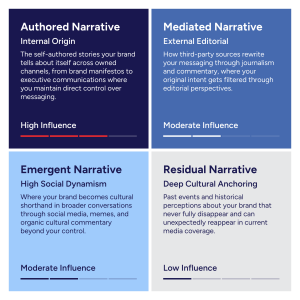
The authored narrative includes the self-authored stories a company tells about itself, whether that be its mission, origin, or raison d’être. Such narratives often feature in brand manifestos, company websites, and across media touchpoints, spanning brand campaigns, executive interviews, social content, and investor reports. Here, the brand is actively constructing and projecting its perception of itself and how it seeks to be perceived.
Relevant Metrics:
This is about ensuring the message you’re putting out is landing as intended with your team and your audience alike.
The mediated narrative represents how third-party sources interpret and reshape your messaging as it passes through editorial filters. These stories live in journalism, industry commentary, as well as influencer and user-generated content where your brand becomes subject to external interpretation.
Relevant Metrics:
Focus here is not on volume but on the quality of how your story is retold and by whom.
The emergent narrative is where your brand meaning gets democratized and redefined by culture itself. Your brand starts appearing not as the primary subject, but as contextual shorthand in broader conversations. Associations develop organically through social media, memes, and cultural commentary, creating sticky symbolic meanings that operate largely beyond your marketing influence.
Relevant Metrics:
This is where you detect cultural shifts, rising tension, or unexpected symbolic associations.
The residual narrative represents your brand’s cultural memory, such as deep associations and historical perceptions that never fully disappear from public consciousness. Past crises, legacy positioning, or outdated perceptions can suddenly resurface in current coverage, even when discussing unrelated developments.
Relevant Metrics:
These are the ghosts that haunt your narrative, often invisible until triggered by a new event.
After seeing one too many crises catch teams off guard, we’ve come to recognize that these “surprises” are never random. The warning signs are always there, scattered across channels, but, as mentioned, most media monitoring setups are calibrated for vague, surface-level signals.
These four red flags, grounded in the “Narrative Influence Quadrant,” offer a sharper lens, especially for dialect-rich markets like the Arab world, where language nuance and fast-moving sentiment demand more than reactive monitoring. Spotting them early gives your brand the chance to respond with confidence and avoid damage control.
Red flag #1: Message mutation (“Authored narrative” layer)
Message mutation is where you lose control of your authored narrative. Your carefully engineered message begins changing the moment it enters the broader media ecosystem. It is not necessarily a case of mistranslation but gradual erosion of meaning that builds as your content passes through different cultural contexts, editorial filters, and linguistic communities. Each retelling moves further from your strategic intent, but the accumulated effect only becomes clear when sentiment changes unexpectedly or when stakeholders interpret your communications in surprising ways.
What to monitor:
Red flag #2: Echo chamber escalation (“Mediated narrative” layer)
Echo chamber escalation happens when one negative story gets repeated across multiple outlets, creating the illusion of widespread industry consensus. Once this pattern starts, it becomes the new baseline for how media covers your brand, making it much harder to correct the narrative. Multiple outlets end up repeating nearly identical framings of your brand, building artificial consensus around stories that may not reflect reality. This is especially dangerous because your monitoring dashboards might register this as increased coverage volume when it’s actually coordinated narrative distortion.
What to monitor:
Red flag #3: Influencer backchanneling (“Emergent narrative” layer)
Your brand meaning gets democratized and redefined by culture rather than controlled by corporate communications. Once you become symbolic shorthand for broader concepts, that association becomes incredibly sticky and difficult to modify through traditional marketing. Your brand starts appearing in influencer content as contextual reference points in discussions about broader industry or cultural issues. While positive associations can benefit your brand, this becomes a red flag when the symbolic meaning shifts away from your strategic positioning or turns negative.
What to monitor:
Red flag #4: Legacy resurgence (“Residual narrative” layer)
Residual narratives represent your brand’s cultural memory, as in the deep associations that never fully disappear from public consciousness. These metanarratives can reactivate unpredictably and immediately reframe how all current communications get interpreted. Past incidents, crises, or perceptions suddenly resurface in current coverage even when unrelated to current events, causing all your activities to be viewed through historical lenses.
What to monitor:
When these dimensions are thoughtfully integrated with the capabilities that monitoring tools generally provide, media monitoring becomes a more powerful strategic function. It allows teams to connect scattered data points to coherent storylines, surface insights that inform decision-making, and understand how their brand is positioned amid an increasingly fragmented and volatile information environment.
This strategic approach becomes even more critical in culturally complex markets. As Yara Milbes, our VP of Marketing, notes, in MENA markets where communication is deeply influenced by cultural nuance and linguistic diversity, brands compete on trust, context, and positioning rather than features alone. This requires understanding your audience far beyond demographics through real-time, multilingual insights across every platform.
Yet the reviews you read online reveal a fundamental gap between what monitoring tools promise and what this strategic reality demands. Professional acceptance of these limitations creates the exact blind spots where narratives slip away from corporate control. In markets where brands compete for narrative dominance itself, your public position depends on comprehensive intelligence that captures cultural context, not just mention counts.
These challenges have prompted some teams to reconsider the purpose of media monitoring, not just what it captures. At Lucidya, this shift in intent has informed our approach to monitoring in high-context, dialect-rich markets. Rather than simply logging mentions, the goal is to interpret narratives as they evolve, by spotting early mutations, decoding sentiment shifts, and understanding when legacy perceptions resurface. When media monitoring serves as a source of narrative intelligence, its value extends beyond metric tracking to become the strategic force that protects and elevates your brand.
Lucidya’s Media Monitoring was built to deliver this intelligence. With proprietary AI supporting 15+ Arabic dialects and cross-platform monitoring architecture achieving 92% accuracy, it transforms you from a reactive tracker into a proactive strategist who models how brand perception evolves across influence layers. So, when leadership asks difficult questions, instead of damage reports, you provide the strategic foresight that allowed your team to act before the threat crystallized.


.svg)
Lucidya is the leading AI-native platform for customer experience intelligence in the Arab World. With its unique AI and NLU capabilities, this CXM platform is designed to give brands the power to deliver game-changing customer experiences anywhere in the region.
Lucidya connects all your customer-facing channels — social, media, surveys, and support — into one intelligent system. It turns raw data into actionable insights so your teams can monitor sentiment,tailor messaging, protect reputation, boost satisfaction, all in real time.
Unlike generic AI tools, Lucidya’s AI is developed fully in-house and trained on Arabic — including 15 dialects — ensuring unmatched accuracy for sentiment and tone detection in the MENA region.
Yes. Lucidya complies with Saudi PDPL, GDPR, and SOC2 standards. Data is encrypted, securely stored, and can be hosted regionally to meet compliance needs.
Lucidya is the leading platform for customer experience management in the Arab World. With unique AI and NLU capabilities, this CXM platform is designed to give brands the power to deliver game-changing customer experiences anywhere in the region.
Lucidya is the leading platform for customer experience management in the Arab World. With unique AI and NLU capabilities, this CXM platform is designed to give brands the power to deliver game-changing customer experiences anywhere in the region.
Lucidya is the leading platform for customer experience management in the Arab World. With unique AI and NLU capabilities, this CXM platform is designed to give brands the power to deliver game-changing customer experiences anywhere in the region.
Lucidya is the leading platform for customer experience management in the Arab World. With unique AI and NLU capabilities, this CXM platform is designed to give brands the power to deliver game-changing customer experiences anywhere in the region.

.svg)


.svg)






.png)

%20with%20competitive%20intelligence_640x774.webp)