.svg)



Marketing & Brand
The power of zero- and first-party data: A marketer’s guide to smarter engagement
As third-party data loses value, zero- and first-party data give marketers a more trusted way to understand customers and personalize engagement.
As third-party data loses value, zero- and first-party data give marketers a more trusted way to understand customers and personalize engagement.


Many marketers are still treating data like an all-you-can-eat buffet.
“More stations. More varieties. More options.” They pile their plates high with website visits, bounce rates, ad impressions, email opens, click-through percentages, social media engagements, and third-party data, hoping quantity will somehow transform into quality insights.
But the dining experience is changing.
With 84% believing data privacy is a human right and close to half of consumers distrusting companies with their website behavior and cookie data, the buffet is shrinking. Third-party cookies, once a main dish, are becoming harder to find on the menu, and privacy regulations now stand like nutrition labels on every dish, forcing marketers to rethink their data diet.
This shift brings remarkable opportunities.
Zero- and first-party data, willingly shared by customers, generates 2.9x the revenue per ad compared to third-party alternatives. Because transparency builds trust. Trust encourages sharing. And sharing enables the kind of personalization that makes customers stay long after the cookies are gone.
Zero-party and first-party data outperform third-party cookies for personalization for three reasons. First, they are collected directly from the customer with clear consent, making them more accurate and legally defensible. Second, they do not degrade when browsers block cookies or when users clear their history. Third, they generate stronger advertising value because they reflect real preferences and behaviors rather than inferred or aggregated signals.
Third-party data is fracturing due to three primary pressures:
Beyond technical fragmentation, third-party data comes with serious flaws. It often misidentifies users, cannot distinguish between multiple people sharing a device, and degrades rapidly as cookies are cleared. Even when available, it typically uses incompatible identity structures, lacks contextual relevance, and arrives disconnected from your first-party systems. By the time you integrate it, it is often already outdated.
The most significant problem is trust. Brands that openly gather information, give customers control, and offer fair value in return earn ongoing access to better data. Those that operate in the shadows risk losing both.
Zero-party data is information a customer intentionally and voluntarily shares with a brand. This includes survey responses, preference center selections, quiz answers, communication preferences, and stated purchase intentions. Because the customer shares it directly, zero-party data carries built-in consent and tends to be highly accurate.
Marketers collect zero-party data without friction by making the exchange feel valuable to the customer. Effective methods include:
First-party data is information a company collects directly from customer interactions on its own channels. This includes website behavior, purchase history, email engagement, CRM records, app usage, and support conversations. It is owned entirely by the brand and reflects what customers actually do, rather than what they say.
Zero-party data is explicitly provided by the customer. First-party data is observed through the customer’s behavior on owned channels. Zero-party data tells you what customers say they want. First-party data shows what they actually do. The two are complementary: stated preferences reveal intent, while behavioral signals validate it.
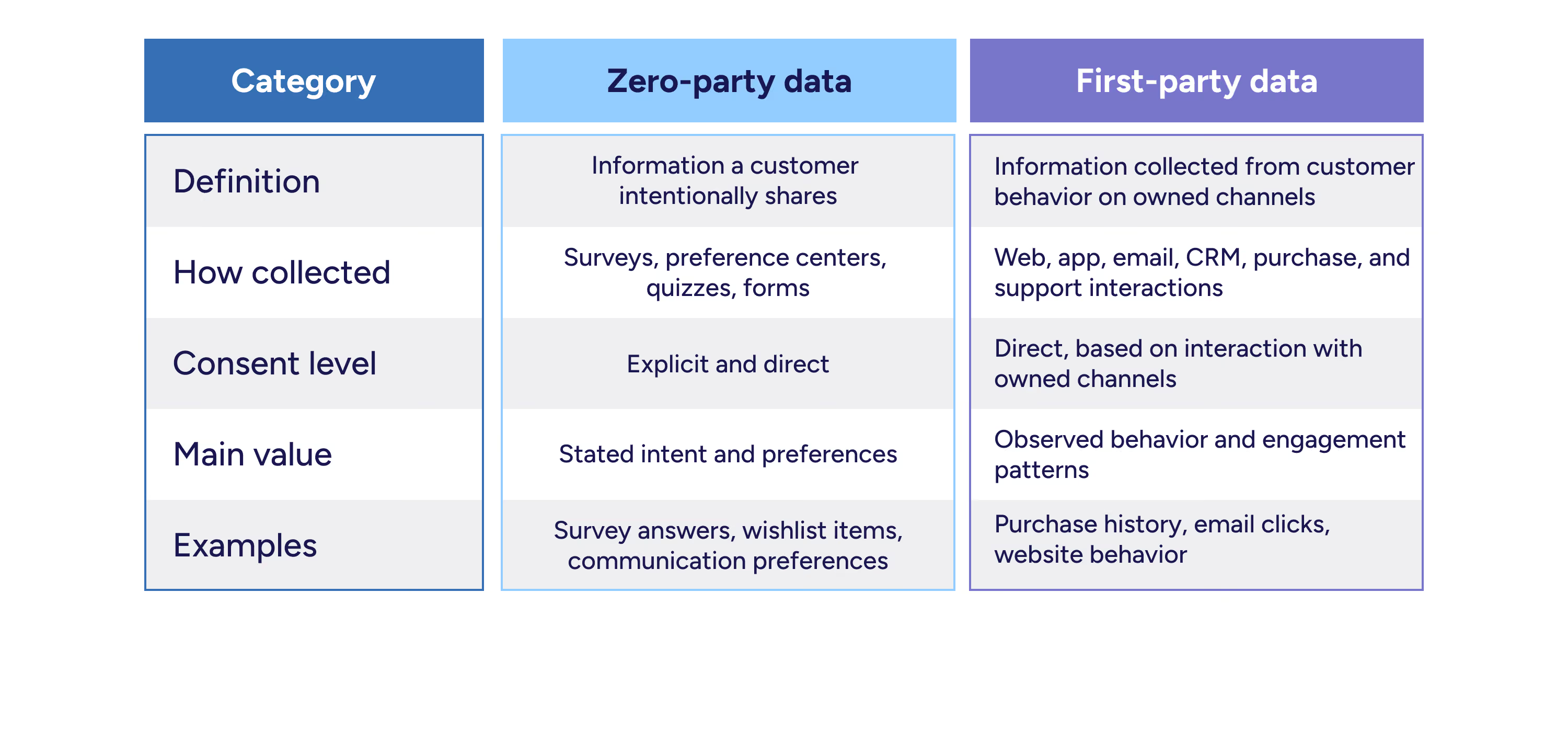
Zero-party data: Information customers intentionally share, such as preferences, survey answers, quiz responses, and communication choices.
First-party data: Information collected from owned interactions, such as website visits, purchases, email engagement, CRM records, and support history.
Best practice: Use zero-party data to understand what customers say they want, and first-party data to validate what they actually do.
Zero-party and first-party data work together by combining what customers say with what they actually do. Zero-party data reveals stated intent: a customer selects “premium travel” as a preference in a survey. First-party data validates behavior: the same customer repeatedly browses family package pages on your website. A unified customer profile that holds both signals allows the brand to send a family-friendly premium travel offer rather than a generic promotion.
Without zero-party data, the behavioral signal lacks context. Without first-party data, the stated preference lacks validation. Together, they produce a more accurate picture of who the customer is and what they are ready to act on.
Consent-based data collection improves customer trust because it gives customers control. When a brand is transparent about what it collects, why it collects it, and what value the customer receives in return, customers are more willing to share. That willingness produces more accurate zero-party data, which enables more relevant personalization, which reinforces the relationship.
Privacy regulations including GDPR, CCPA, and Saudi PDPL formalize this expectation: brands must collect data with clear consent and give customers the ability to withdraw it. Brands that treat consent as a foundation rather than a compliance checkbox build a data advantage that compounds over time.
The harsh truth is that even the best customer data provides limited value when it is trapped in disconnected systems. Your email platform knows open rates but cannot see website behavior. Your CRM tracks conversations but does not know support history. Your analytics tool measures page views but misses offline interactions.
According to BCG, less than one-third of marketing teams successfully integrate data across channels. A customer explicitly tells you they are interested in Product A through a survey, but your sales team calls them about Product B. Or your company sends a “How’s your new purchase working out?” email on the same day the customer filed a support ticket about the product not working.
These disconnects happen because many companies still follow an outdated model:
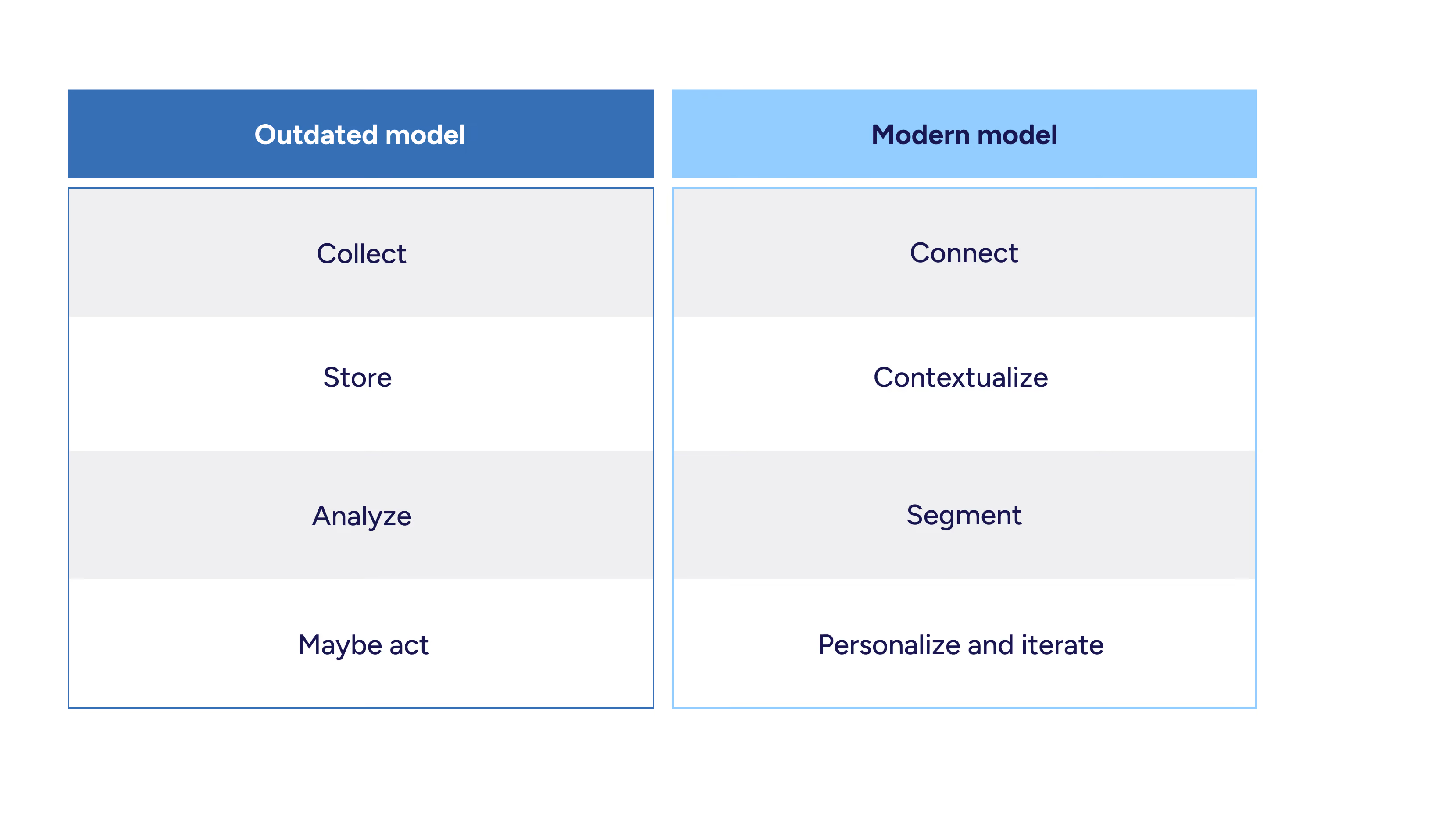
The outdated approach treats data as something to accumulate rather than activate, resulting in insights that arrive too late to impact customer experiences. The modern model is cyclical and self-reinforcing: each cycle feeds the next, so new customer signals immediately influence how you group people, what you offer them, and when.
A customer data platform, or CDP, is a system that collects, unifies, and activates customer data from multiple sources into a single, continuously updated customer profile. For zero- and first-party data, a CDP connects survey responses and preference selections with website behavior, purchase history, email engagement, and support interactions so every team works from the same view of the customer.
Lucidya Profiles brings this model to life by connecting your marketing, sales, and support systems to maintain a single, real-time view of each customer, no matter where the data comes from.
What a customer clicks, shares, or says to support no longer lives in separate systems; it all informs the next message, the next experience, and the next offer. Precision targeting becomes second nature because your segments are shaped by real behavior, timing, and genuine customer intent. This clarity aligns teams: product sees what features customers care about, support understands the context behind every ticket, and sales knows who is truly ready to buy.
In MENA markets, owned customer data comes with an extra layer of complexity and advantage. Feedback often arrives in Arabic dialects, across channels like WhatsApp, social, surveys, and support, and within cultural contexts that generic Western tools routinely misread. A zero- or first-party data strategy here cannot just be privacy-first; it also has to be language-native and context-aware.
Lucidya is built for this environment. Its Arabic-native AI helps brands understand stated preferences, behavioral signals, and sentiment in the way customers actually express them, so consent-based personalization feels relevant rather than translated.
Building a first-party data strategy after third-party cookies requires five steps:
The loop is self-reinforcing: each cycle produces better data, sharper segments, and more relevant experiences.
Lucidya Survey helps brands collect zero-party data through Arabic-native surveys, preference flows, onboarding questions, and feedback forms that customers willingly complete because the value exchange is clear.
Social Listening captures public and owned social signals, while Lucidya Profiles unifies those signals with survey feedback, behavioral data, and CRM context into a single customer view.
OmniServe brings support history into the same profile, so no interaction is siloed and every response starts with context rather than guesswork.
For teams ready to act on that intelligence, our AI Agent for marketing teams helps turn owned customer data into timely, personalized engagement.
Built for the Arab world, Lucidya’s AI is trained on Arabic, including 15 dialects, so zero-party feedback collected in Arabic is analyzed with high sentiment accuracy rather than approximated by a generic model.
The shift to zero- and first-party data aligns good business with good ethics. Customer trust, data quality, and personalization all reinforce each other in a virtuous cycle. Your competition may still be debating cookieless strategies while you are building something far more valuable: a business customers actively want to share data with.
That is not merely good marketing. That is checkmate.
Zero-party data is explicitly given by the customer, such as survey answers or stated preferences. First-party data is observed through customer behavior, such as website visits, purchases, app usage, or support history. Both are owned by the brand, but they capture different signals.
They come with clearer consent, are more accurate, and are collected directly from the customer. They also generate stronger advertising value than third-party alternatives and are not affected in the same way by cookie restrictions or browser changes. Because they reflect real preferences and behaviors, they are more reliable for personalization.
Zero-party data examples include survey responses, preference center selections, quiz results, product ratings, wishlist items, communication preferences, and stated purchase intentions.
First-party data examples include website browsing behavior, purchase history, email opens and clicks, app usage, CRM records, customer service history, and social media interactions with the brand.
Marketers can collect zero-party data through surveys, onboarding flows, preference centers, post-purchase feedback forms, loyalty program sign-ups, and WhatsApp polls. The key is to offer clear value in exchange for the information and keep the interaction simple.
A CDP connects data from multiple owned channels into a single, real-time customer profile. It allows marketing, sales, and support teams to act on both stated preferences and behavioral signals without switching between disconnected systems.


.svg)


.svg)




















%20with%20competitive%20intelligence_640x774.avif)