Building autonomous AI Agents that drive measurable CX impact
The landscape of customer service is evolving at an unprecedented pace. As businesses race to meet rising consumer expectations, the technology powering customer interactions has reached a pivotal inflection point.
February 24, 2026
|
10
min read
|
Author:
Qaiser Khan
Customer service is moving from automated replies to autonomous resolution. As businesses race to meet rising consumer expectations, the technology powering customer interactions has reached a pivotal inflection point. This matters even more for brands operating in regulated, Arabic-speaking markets, where language nuance and governance requirements directly shape customer outcomes.
What worked even two years ago, static workflows, scripted responses, and rule-based automation, is no longer sufficient. Customers today don't just want answers; they expect intelligent, contextual assistance that resolves their issues on the first interaction. This seismic shift has created both a challenge and an opportunity: to reimagine customer experience through the lens of truly autonomous AI.
Users now expect dynamic, autonomous systems capable of solving far more complex queries than any traditional chatbot can handle. At the same time, businesses that adopt autonomous AI agents for customer service, developed the right way, are generating meaningful ROI from both efficiency gains and the lifetime value of satisfied customers.
Autonomous AI agents for customer service are AI systems that understand customer intent, retrieve context, use approved tools, take action inside business systems, and resolve issues with minimal human involvement. Their value is not just faster response, but measurable resolution.
Key takeaways
Resolution over redirection: Modern CX requires autonomous agents capable of solving complex queries in one interaction, moving beyond static chatbot workflows.
Strategic foundations first: Successful AI deployment requires clear problem definition, the right success metrics, and continuous feedback loops, before any technical build begins.
Essential capabilities: High-ROI agents implement memory, real-time analytics, and rigorous safety guardrails against prompt injections and context manipulation.
Unified intelligence: Platforms like Lucidya connect AI agents with OmniServe to maintain context and continuity across customer channels.
What are autonomous AI agents for customer service?
Autonomous AI agents for customer service are AI systems that can understand a customer's request, reason through the steps required to resolve it, access connected business systems, take action, and close the issue with minimal human involvement. Unlike rule-based chatbots that follow predefined scripts, autonomous agents can handle dynamic, multi-step conversations, retrieve customer history, update records, process requests, and escalate to a human agent when the situation requires it.
They sit beyond both rule-based automation and generative AI assistants. A generative assistant can draft a response. A Lucidya AI Agent can understand intent, use approved tools connected to CRM, ticketing, and billing systems, and complete tasks such as creating tickets, updating account details, routing requests, and logging outcomes back into customer records.
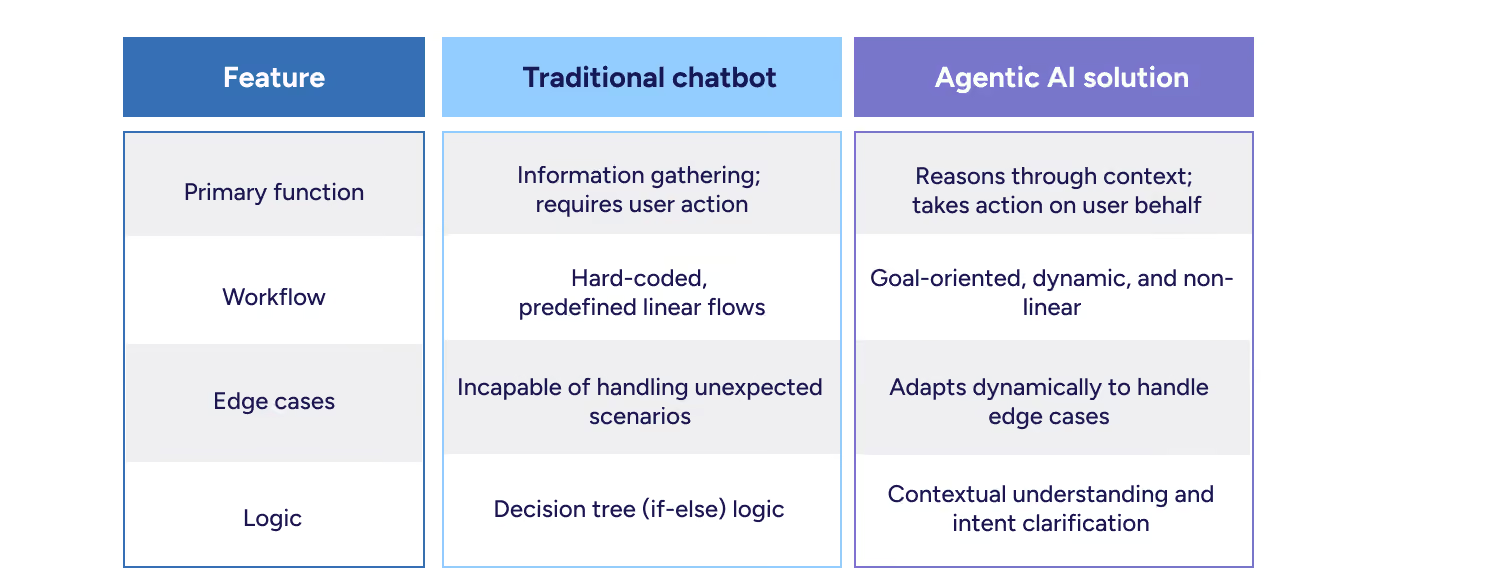
AI agents vs. chatbots
Traditional chatbots operate on fixed decision trees. They can retrieve information and direct customers to resources, but they cannot take action on a customer's behalf. Autonomous AI agents reason through context, use tools connected to CRM, ticketing, and billing systems, and complete tasks without requiring the customer to take additional steps.
How autonomous AI agents work in practice
Autonomous AI agents work through a compact agentic AI architecture that combines intent detection, context retrieval, reasoning, tool use, and governed execution.
Intent detection: The agent identifies what the customer is trying to achieve.
Context and memory retrieval: It pulls relevant customer history, prior interactions, and current conversation state.
Reasoning and planning: The agent determines the next best action and the sequence required to complete it.
Tool and system access: It uses approved integrations across CRM, ticketing, billing, or knowledge systems.
Action execution or escalation: It completes the task or escalates to a human agent when confidence, policy, or sensitivity requires it.
Outcome learning: Feedback from the interaction helps improve prompts, retrieval, tool calling, and evaluation over time.
How autonomous AI agents improve customer experience outcomes
Autonomous AI agents improve customer experience outcomes by shifting the measure of success from response speed to resolution rate. A traditional chatbot that directs a customer to a knowledge base article deflects the interaction but does not resolve it. An autonomous agent that detects the customer's intent, retrieves their account history, processes the request, and confirms the outcome in the same conversation resolves it.
The difference shows up in first contact resolution rates, CSAT scores, and customer retention. Agents that resolve issues on the first interaction reduce the frustration of repeat contacts, eliminate the need for customers to re-explain their situation, and create the kind of experience that builds long-term loyalty rather than just closing a ticket.
Why AI agents alone are not a silver bullet
Despite the advantages above, AI agents are not a silver bullet. Many agentic AI solutions still struggle to deliver ROI and drive real customer value.
The reason is a common misconception: many organizations treat agentic AI deployment as a simple replacement: remove the old chatbot and install the new agent. That approach fails because it imports the same structural problems into a more capable system. Successful AI agent implementations require careful problem definition, strategic planning, and a holistic approach to customer experience design.
The difference between agents that deliver transformational value and those that underperform comes down to how well the following foundational elements are addressed.
1. Understand your customer pain
What is it that your customer is struggling with? Are they not getting the right information at the right time, or is there one specific action that takes the most time? If the bottleneck is understood, that is half the battle.
2. Define success metrics
Once the problem statement is well understood, determine which metric should measure success. This could be the number of tickets processed, resolution rate, CSAT score, or churn rate. Select the metric that aligns with the problem statement.
At Lucidya, we see this repeatedly: most failed AI deployments are not technical failures; they are problem-definition failures.
3. Implement memory
The AI agent needs to remember the conversation for a specific user. If a user sends a message and ten minutes later the conversation resets from the start, the agent drives frustration rather than satisfaction.
4. Enable continuous learning
A feedback loop is required, one that tells the AI agent whether its response was correct or could have been improved. Once this information is provided, it can be used to optimise components within the agent such as prompts, tool calling, and retrieval. Without this, the agent will not improve.
5. Deploy analytics
An autonomous AI agent without analytics is operating blind. There must be structured visibility into how the agent is performing on every layer: conversation quality, tool usage, resolution pathways, escalation triggers, and customer sentiment shifts.
6. Establish evaluation
Before releasing any agentic system, it needs to be fully tested. Simulations and synthetic users are one way to validate agent behaviour across dynamic, open-ended interactions.
7. Build guardrails
Privacy and safety are critical to any agentic AI system. Pre-release testing must include jailbreaking attempts, prompt injection testing, toxic language detection, and context manipulation scenarios. Without this, agentic systems can become a security vulnerability.
For organisations operating in MENA, this also means validating Saudi PDPL and GDPR requirements before go-live, and testing Arabic-language interactions with dialect-aware safety layers. For a deeper view on governance, see Agentic AI is not about intelligence. It's about control.
How to measure the ROI of autonomous AI agents
Measuring the ROI of autonomous AI agents starts with choosing the right metric for the problem you are solving. The most reliable indicators are resolution rate, first contact resolution, average handling time, cost per resolved interaction, CSAT score trend, escalation rate, and automation rate.
Resolution rate: The percentage of interactions fully resolved by the agent without human intervention. This is the clearest signal of AI agent ROI.
First contact resolution: Whether the issue was closed in a single interaction. Strong performance here signals lower customer effort and fewer repeat contacts.
Average handling time: The total time to reach a resolved outcome. Lower handling time matters only if resolution quality stays high.
Cost per resolved interaction: The operating cost to solve one issue. This connects service performance to a business case finance teams can validate.
CSAT score trend: Satisfaction over time after deployment. This shows whether faster automation is also producing better experiences.
Escalation rate: The percentage of cases handed to human agents. This reveals where the agent needs better context, tools, or policy boundaries.
Automation rate: The share of interactions touched by the agent. Useful, but secondary high automation without high resolution only masks poor outcomes.
As we explain in Stop measuring responses. Measure resolution., resolution rate matters more than deflection rate. An agent that deflects a query to a knowledge base article may reduce volume. An agent that resolves the issue, updates the record, and confirms the outcome creates measurable loyalty and retention impact. This distinction becomes even more important when your strategy is focused on minimizing customer churn.
The foundations Lucidya builds from day one
The components above are not optional extras; they are the foundations of any agentic solution expected to deliver real business value.
At Lucidya, we start by understanding your customer support workflow in depth: the true pain points, the operational bottlenecks, and the success criteria that matter to your business. This is especially important in MENA, where Arabic dialect variation, regulated service environments, and channel fragmentation can undermine resolution if the agent lacks the right context and controls.
We embed memory, analytics, evaluation, guardrails, and continuous learning directly into the agent development lifecycle from day one. Our internal monitoring and evaluation services enable optimisation at scale, ensuring agents improve over time rather than degrade, while aligning with Saudi PDPL, GDPR, and enterprise governance requirements.
Lucidya Profiles gives the Lucidya AI Agent a real-time view of each customer's history, sentiment, and prior interactions, so the agent can personalise its response from the first message without asking the customer to repeat themselves. OmniServe brings conversations from every channel into a single, unified environment, ensuring continuity, visibility, and no missed customer signals.
Building AI agents to drive CX excellence is not about deploying a smarter chatbot. It is about designing an intelligent, measurable, and continuously improving system that delivers real outcomes: higher resolution rates, stronger customer satisfaction, and long-term loyalty.
That is the difference between experimentation and impact.
What is the difference between agentic AI and generative AI in customer service?
Generative AI produces responses. Agentic AI plans, decides, uses tools, and takes actions toward a goal. In customer service, the distinction matters because generative AI can draft a reply, but agentic AI can actually process the refund.
Can autonomous AI agents handle complex or sensitive customer issues?
They can handle many complex issues, but they should be configured to escalate sensitive, emotionally charged, legally risky, or policy-boundary cases to a human agent. Escalation logic is a design decision, not a limitation.
What governance controls should be in place before deploying an autonomous AI agent?
Role-based access, a policy engine defining permitted actions, approval workflows for high-risk actions, audit trails, escalation thresholds, kill switches, and jailbreak testing should all be in place before deployment. These are prerequisites for enterprise deployment, not optional extras.
How long does it take to see ROI from an autonomous AI agent?
It depends on deployment scope and integration depth. Organisations that start with high-volume, repeatable workflows and connect the agent to existing CRM and ticketing systems typically see measurable resolution rate improvements within weeks of go-live.
Do autonomous AI agents work for Arabic-speaking customers?
They can, if the underlying AI is trained on Arabic and regional dialects. Generic models often fail to capture dialect-specific intent and sentiment, which directly affects resolution accuracy. Platforms built natively for Arabic, such as Lucidya AI Agent, are better suited for MENA customer service environments where dialect variation and cultural nuance matter.
Lucidya is an AI-native customer experience management platform built specifically for MENA markets. It combines social listening, omnichannel customer service, media monitoring, survey tools, and AI-powered analytics into one platform, with native support for 17 Arabic dialects and 92% sentiment analysis accuracy in both Arabic and English.
What channels does Lucidya connect for customer experience management?
Lucidya monitors and unifies data across six channel categories. Social media includes X (Twitter), Instagram, Facebook, YouTube, TikTok, and Snapchat public accounts via native ingestion and APIs. Media covers news sites, blogs, and forums through crawlers and APIs. Reviews are tracked through Google Reviews via API integration. Messaging channels include WhatsApp via official API integration, email via SMTP, and social DMs across platforms. Live chat is handled natively through OmniServe. Voice and call center data is ingested via API integration. Survey and website feedback is collected through Lucidya's native Survey product and embedded website scripts.
How accurate is Lucidya's Arabic sentiment analysis compared to other platforms?
Lucidya's sentiment analysis reaches 92% accuracy in both Arabic and English. Unlike Western platforms that require extensive customization for Arabic content, Lucidya's AI is built in-house and trained natively on 17 Arabic dialects (from Khaliji to Maghrebi) making it significantly more accurate for MENA markets than global alternatives like Brandwatch or Sprinklr. Lucidya's Arabic NLP engine supports 17 dialects across seven major dialect groups: Modern Standard Arabic (MSA), Saudi Arabic (Najdi, Hijazi, and other regional Saudi variations), Yemeni Arabic (including White/Yemeni dialect variations), Khaleeji Arabic (Emirati, Bahraini, and Kuwaiti dialects), Egyptian Arabic, Shami Arabic (Palestinian, Syrian, and Lebanese dialects), Maghrebi Arabic (Moroccan, Libyan, and Algerian dialects), and Iraqi Arabic.
How does Lucidya handle data privacy and compliance in Saudi Arabia and the MENA region?
Lucidya complies with Saudi PDPL, GDPR, SOC 2, ISO 27001, and SDAIA requirements. Data is encrypted, securely stored, and can be hosted regionally to meet local compliance needs across the Gulf.
What types of organizations use Lucidya?
Lucidya serves enterprise brands, government entities, and large regional organizations across Saudi Arabia and the broader MENA region. Key sectors include banking and financial services, government and public sector, travel and tourism, insurance, hospitality, logistics, and telecommunications. The platform is built for organizations that need Arabic-native AI at scale, not generic tools adapted for the region.
What products make up the Lucidya platform?
Lucidya is a suite of six integrated products. Social Listening monitors brand conversations, competitor activity, and emerging trends across social media channels in real time. OmniServe is an omnichannel inbox that unifies customer messages from social media, WhatsApp, email, and more into one AI-powered workspace. Profiles is a Customer Data Platform that builds 360° customer views by unifying behavioral, sentiment, and demographic data. Survey collects and analyzes customer feedback across channels with Arabic-native sentiment analysis for open-text responses. AI Agent automates customer interactions in Arabic and English across WhatsApp, social media, and other channels with support for 17 Arabic dialects. Media Monitoring tracks brand presence across online news, blogs, and broadcast media. All six products share the same Arabic-native AI engine and can be deployed together as a full CXM suite or individually based on business needs.
How does Lucidya differ from other enterprise CX platforms for MENA markets?
Most enterprise CX platforms are built for English-language markets and adapted for Arabic as an afterthought. Lucidya is built from the ground up for MENA, with in-house Arabic NLP trained natively on 17 dialects achieving 92% sentiment accuracy. The platform complies natively with Saudi PDPL and regional data residency requirements, offers local hosting options, and is designed specifically for the regulatory, linguistic, and cultural context of Gulf enterprise. This means MENA brands get accurate results without the customization costs and accuracy tradeoffs that come with adapting a global tool for the region.
Why do Western CX platforms struggle with Arabic markets?
Most Western CX platforms are built on AI models trained predominantly on English language data. When applied to Arabic, these models struggle with right-to-left script, dialect variation, and the significant differences between Modern Standard Arabic and the 17+ spoken dialects used across MENA. The result is inaccurate sentiment detection, missed context, and insights that don't reflect how Arabic speakers actually communicate. For brands operating in Saudi Arabia, the UAE, or broader MENA markets, this translates directly into poor decisions based on unreliable data.
Take the next step toward a smarter customer experience
Dive deeper with fresh perspectives for smarter CX

.svg)






.svg)




.svg)
























%20with%20competitive%20intelligence_640x774.avif)