.svg)


%20with%20competitive%20intelligence_1080x328.webp)
Research & Insights
How to learn from the best (and worst) with competitive intelligence
Imagine playing chess blindfolded. Every move feels confident until you realize the board has changed. Your queen is gone. Your opponent is five moves ahead.
Imagine playing chess blindfolded. Every move feels confident until you realize the board has changed. Your queen is gone. Your opponent is five moves ahead.


“Only the paranoid survive.”
— Andrew Grove, former CEO of Intel
Imagine playing chess blindfolded. Every move feels confident until you realize the board has changed. Your queen is gone. Your opponent is five moves ahead. That’s what running a business without competitive intelligence looks like.
The window for action is shorter than ever. As you prepare, others are already executing and winning. Customers do not wait. They do not forgive easily. And they are not comparing you to your closest competitor anymore. They are comparing you to the best experience they have ever had. Period.
Trends rise and crash before lunch. Expectations shift while you are still polishing your brief. The winners are not just creative. They are aware. They see what is coming and move before the rest of the market even blinks.
Competitive Intelligence is not a crystal ball. It is a system. A practice. A mindset.
It is how leading teams decode the signals, learn from the loud and the quiet, and make bold decisions backed by truth. Not instinct. Not assumptions. Real data. Real patterns. Real advantage.
So the question is not whether you need Competitive Intelligence. The question is how fast you are willing to use it.
Competitive Intelligence is not about copying your competitors. It is about learning from their wins and their mistakes, then using those insights to shape your own strategy. The best brands track market signals, decode customer sentiment, and adapt in real time. This blog breaks down what CI really is, how to learn from both success and failure, and how to turn intelligence into action with Lucidya.
Competitive Intelligence, or CI, is the process of gathering, analyzing, and acting on information about your competitors and the market at large. Think of it as strategic situational awareness: knowing where to stand, when to move, and what to say when you get there.
But CI is not limited to tracking what other brands post on social media. Its true power lies in uncovering strategic signals beyond the surface.
According to a report by McKinsey & Company, companies that actively invest in Competitive Intelligence capabilities are 33 percent more likely to outperform their peers in revenue growth and market positioning.
Signals can include product launches, pricing changes, brand messaging, customer sentiment, SEO trends, and influencer moves; giving you a full view of both market shifts and audience behavior.
This data paints a complete picture. And the more complete the picture, the better your ability to make informed decisions across every department, from product to sales to CX. A white paper by Valona Intelligence supports this, emphasizing that cross-functional decision-making is significantly more effective when backed by structured CI programs. It enables teams to move from isolated insights to coordinated, data-driven strategy.
And according to Gartner Peer Insights, high-performing marketing teams are 2.5 times more likely to leverage CI tools regularly, confirming that competitive and market intelligence is no longer a luxury but a standard for organizations aiming for consistent market leadership.
It is not an occasional tactic. It is a permanent advantage.
How top brands use CI in 5 moves:
Success leaves clues.
When a brand rises to the top, it is usually the result of deliberate moves, consistent messaging, and an obsessive focus on the customer.
The goal is not to envy their position but to dissect it.
Start by looking at how top performers operate. How do they communicate? Which messages actually earn engagement? How do they position themselves in moments of cultural or economic change? What values do they highlight? Do their customers trust them, and more importantly, why?
Global Case: Netflix’s Content Strategy Powered by CI
Netflix didn’t dominate the streaming world by chance. CI drove one of Netflix’s boldest growth moves: going local before the rest. By analyzing gaps in competitor libraries, monitoring local viewing trends, and listening to regional social media conversations, Netflix spotted a growing appetite for non-English content before most others did.
Instead of relying solely on global hits, Netflix invested in original local-language productions across key markets like South Korea, Spain, and the Middle East. This decision wasn’t based on instinct. It was informed by a structured view of what local audiences were craving and what competitors weren’t delivering.
The result? A massive global footprint with over 230 million subscribers by 2023 and cultural phenomena like Squid Game and Money Heist that topped global charts. This move not only boosted engagement in local markets, it reshaped what global entertainment could look like.
That’s CI at scale: using insights to guide billion-dollar decisions in product, positioning, and expansion.
Now, let’s flip the lens.
Failing or underperforming competitors leave breadcrumbs behind. Their mistakes expose blind spots. Their silence reveals confusion. Their tone-deaf campaigns highlight a lack of connection with the audience.
Some common red flags include:
Failure to adapt: Quibi’s $1.75B misread and a missed CI opportunity
Quibi launched with huge funding and big-name talent, but it failed to study what its competitors were doing right or why audiences were flocking elsewhere.
While TikTok and YouTube Shorts thrived on snackable, shareable, user-driven content, Quibi doubled down on premium, unshareable content locked to a mobile-only experience. CI would’ve revealed what platforms were winning on and how viewers actually behaved. Instead, Quibi ignored those cues.
Competitor benchmarks, feature comparisons, and social sentiment around user habits were all there to learn from. They just weren’t used. Six months after launch, the platform shut down.
And it’s not just billion-dollar ventures. Here’s a familiar scenario
When food delivery App A launched a buggy update, complaints exploded on social media. Instead of waiting for resolution, its competitor; App B, leveraged CI:
As a result, App B won market share while App A remained silent and lost momentum.
While this specific scenario is commonplace, and similar dynamics are discussed in UX case studies of platforms like Uber Eats and Zomato, it clearly demonstrates how competitive insight plus consumer signals drive real-world advantage.
And that’s what CI is built for.
Learning from failure does not mean waiting for your competitors to implode. It means paying attention to where they fall short and asking what you would do differently. More importantly, it means listening for what customers wanted that they never got.
Missed opportunities are the most valuable lessons CI can offer.
So, you’ve gathered the insights. Now what?
You don’t copy. You adapt.
Tracking competitors means nothing if you don’t use the insights to shape better strategy. Smart brands build habits around CI. They don’t just report it, they act on it.
According to Crayon’s State of Competitive Intelligence, 57% of CI leaders say their markets are significantly more competitive than they were just four years ago. That shift is pushing high-performing teams to move faster, align smarter, and use CI as a strategic pillar—not just a nice-to-have.
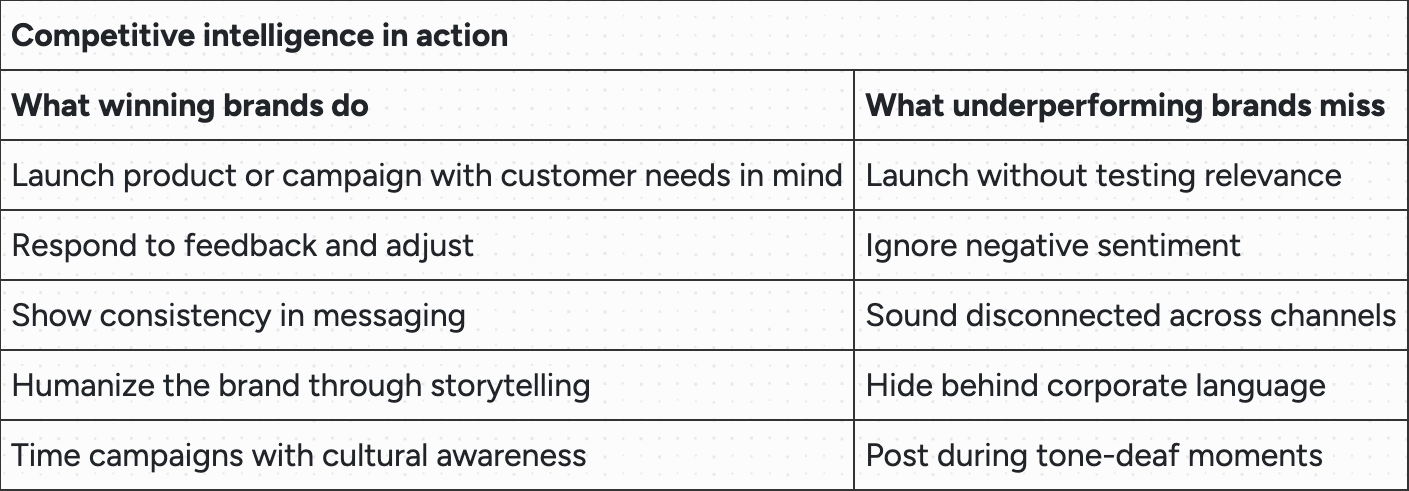
CI doesn’t just help you keep up. It helps you lead. Here’s what that looks like:
To put CI into action, you need more than manual tracking. That’s where platforms like Lucidya make a difference: surfacing real-time sentiment shifts, benchmarking competitor moves, and helping you pivot while the moment is still live.
Knowing the value of CI is one thing. Embedding it into your team’s daily rhythm is where the real edge lies. Here’s how to make it practical, repeatable, and impactful:
Whether it’s a dedicated analyst or a rotating role shared across departments, assign someone to own competitive intelligence. They’re responsible for collecting, curating, and sharing insights consistently.
Set clear, business-aligned goals for your CI process. Are you trying to win more deals? Spot market risks early? Optimize campaign performance? The clearer the objective, the sharper your analysis.
Choose tools that can gather real-time data, benchmark trends, and surface insights without manual digging. Lucidya brings it all together in one AI-powered platform: tracking competitors, sentiment, and market signals across social, news, blogs, and more.
Run monthly intelligence reviews. Share quick CI wins in team meetings. Create a living dashboard that everyone can reference: marketing, sales, product, and leadership.
Translate CI findings into action. Use insights to test new messaging, adjust timing, and prioritize product updates. Monitor results. Refine the playbook. And repeat.
Your competitors are shaping how your customers think, choose, and expect. What started as a reminder has now become a roadmap. Competitive Intelligence isn’t something smart brands add later, it’s embedded in how they operate from day one.
That’s because staying informed is no longer enough. In fast-moving markets, the brands that lead are those that detect shifts early, prioritize with clarity, and move before others even react.
Today, CI has become a strategic driver. It shapes daily decisions, sharpens messaging, influences product and campaign direction, and aligns entire teams around what really matters.
And nowhere is that more critical than in marketing. From refining strategy to optimizing campaigns, identifying market gaps, and shaping influencer playbooks, competitive intelligence gives you the context to act with precision.
Lucidya delivers that competitive clarity. It surfaces real-time signals from social media, news, blogs, and customer conversations, all in one platform. So, you can see what your audience values, where your competitors stand, and how to move with confidence and not assumption.
Lucidya’s AI-powered CXM platform gives you the competitive intelligence you need to stay ahead: track competitors, spot trends, and make smarter marketing decisions.
Explore our solutions and see how Lucidya can elevate your strategy today.
.svg)
Lucidya is the leading AI-native platform for customer experience intelligence in the Arab World. With its unique AI and NLU capabilities, this CXM platform is designed to give brands the power to deliver game-changing customer experiences anywhere in the region.
Lucidya connects all your customer-facing channels — social, media, surveys, and support — into one intelligent system. It turns raw data into actionable insights so your teams can monitor sentiment,tailor messaging, protect reputation, boost satisfaction, all in real time.
Unlike generic AI tools, Lucidya’s AI is developed fully in-house and trained on Arabic — including 15 dialects — ensuring unmatched accuracy for sentiment and tone detection in the MENA region.
Yes. Lucidya complies with Saudi PDPL, GDPR, and SOC2 standards. Data is encrypted, securely stored, and can be hosted regionally to meet compliance needs.
Lucidya is the leading platform for customer experience management in the Arab World. With unique AI and NLU capabilities, this CXM platform is designed to give brands the power to deliver game-changing customer experiences anywhere in the region.
Lucidya is the leading platform for customer experience management in the Arab World. With unique AI and NLU capabilities, this CXM platform is designed to give brands the power to deliver game-changing customer experiences anywhere in the region.
Lucidya is the leading platform for customer experience management in the Arab World. With unique AI and NLU capabilities, this CXM platform is designed to give brands the power to deliver game-changing customer experiences anywhere in the region.
Lucidya is the leading platform for customer experience management in the Arab World. With unique AI and NLU capabilities, this CXM platform is designed to give brands the power to deliver game-changing customer experiences anywhere in the region.


.svg)


.svg)




.png)

%20with%20competitive%20intelligence_640x774.webp)