When brands lack market visibility, customers pay the price
Most customer service teams measure speed. Few measure sight. This blog looks at why visibility into customer history, sentiment, and cross-channel interactions is the real driver of satisfaction, retention, and sustainable growth.
February 10, 2026
|
13
min read
|
Author:
Nagham Tawk
"I've contacted support THREE times about this. Each time I have to explain everything from scratch, like I'm a new customer. Does anyone there actually talk to each other? I'm done."
Sarah M., 7 hours ago
Customer visibility is the ability to see a customer’s history, sentiment, interactions, and support context across every channel in one place. When brands lack that visibility, customers are forced to repeat themselves, agents make decisions with incomplete context, and churn signals are missed until it is too late.
Key takeaways
Context Over Speed: Customers find repeating their issues just as frustrating as long wait times; visibility into history is the primary driver of satisfaction.
The Cost of Blindness: Lack of data visibility leads to "invisible churn," higher agent burnout, and business decisions based on incomplete samples.
Unified Data Framework: Success requires unifying social, chat, and email data into a 360-degree profile that surfaces sentiment in real-time.
AI as an Augmenter: Modern AI should empower human agents with context rather than just replacing them, especially in complex support scenarios.
Regional Nuance: For the MENA region, AI must handle Arabic dialects and cultural nuances to accurately detect customer sentiment.
Customers repeat themselves when support channels, ticket history, CRM records, and previous interaction data are stored in disconnected systems. An agent handling a phone call may see the customer's account but not their prior email, chat conversation, or social complaint. Without a unified view, every channel starts from zero.
This conversation is happening right now, somewhere in your organization, and probably several times today. Your agent isn't incompetent, and your systems aren't technically broken. Something more fundamental is wrong: your customer service is operating blind.
For years, the industry has obsessed over incomplete metrics. Average handle time. First call resolution. Queue wait times. These numbers dominate dashboards and drive decisions, but they're symptoms, not causes. The real question that rarely gets asked is: What does your team actually see when a customer reaches out? For most organizations, the honest answer is almost nothing meaningful.
What a unified customer experience platform actually is
A unified customer experience platform is software that connects customer conversations, interaction history, sentiment data, and support workflows across every channel into a single shared environment. Unlike a CRM, which stores contact records, or an omnichannel helpdesk, which routes messages, a unified CX platform gives every team a complete, real-time view of the customer so that service, marketing, and sales all work from the same picture.
Omnichannel support lets customers contact a brand through multiple channels. Unified CX connects those channels with shared customer context, history, and sentiment so that every interaction feels continuous. The difference is not the number of channels available. It is whether the intelligence travels with the customer across all of them.
Brands need this category because fragmented systems force customers to repeat themselves, prevent agents from acting on full context, and hide the early warning signals that predict churn before it happens. A CRM tells you who the customer is. A connected CX layer tells you what they have experienced, how they feel now, and what your team should do next.
The speed trap: why faster alone isn't the answer
When executives hear customer complaints about support, they typically interpret the feedback as "slow." The natural response is to chase speed. But the research tells a different story.
According to HubSpot research, 33% of customers identify waiting on hold as their top frustration, while an equal 33% cite having to repeat themselves to multiple representatives as the most frustrating part of support.
Vonage's Global Customer Engagement Report reveals that 63% of customers are annoyed when they have to repeat their issue due to missing context and personalization.
The pattern is clear: customers don't hate waiting as much as they hate being forgotten. They don't mind explaining a problem once. They deeply resent explaining it again to someone who should already know.
The true cost of operating blind
When agents lack a shared customer view, support quality degrades in four compounding ways. Customers must repeat their history on every contact, agents make decisions without the context needed to resolve issues accurately, dissatisfied customers churn before retention teams ever see the warning signs, and valuable product and service intelligence dies inside disconnected systems rather than reaching the teams who could act on it.
Fragmented customer data costs organizations in four measurable ways: elevated churn from missed early warning signals, agent attrition driven by the frustration of working without context, operational decisions based on only a small share of actual interactions, and lost revenue from intelligence that never reaches the teams who could act on it. The cost of not acting is not a future risk. It is a current drain on retention, productivity, and growth.
Invisible churn
By the time a customer calls to cancel, they've already decided. The warning signs appeared weeks earlier in declining engagement, increasingly negative sentiment on social channels, and shorter, more transactional interactions. Without visibility into these signals, your retention team fights battles they've already lost.
Forrester research shows that companies investing in call center analytics see a 10–15% increase in satisfaction and a 10–20% reduction in churn. Conversely, Khoros found that 65% of customers have switched brands following poor service. If you want to understand how to catch those signals earlier, see this related article on churn.
Agent burnout that drains your best people
The customer service industry has one of the highest turnover rates of any sector, averaging 30 to 45% annually with some segments reaching 60%. But burnout doesn't come from hard work. It comes from impossible work. When agents lack the context to understand customer issues, daily frustration accumulates. Your best people leave not because the job is difficult, but because it feels pointless.
Decisions based on guesswork
Most customer service teams analyze less than 5% of their total interactions. According to CMSWire, quality assurance teams can only review a small fraction of conversations, creating enormous blind spots. You're running operations based on a sample so small that the patterns you identify might not represent reality at all.
Silos that strangle growth
When customer service operates in isolation from marketing, sales, and product teams, valuable intelligence dies in departmental silos. Product feedback buried in chat transcripts never influences the roadmap. Upsell opportunities flagged by agents never reach sales. The unique customer data that could transform your business exists in fragments, visible to no one in its entirety.
What a unified CX platform should include
A unified customer experience platform should include: a unified inbox that consolidates conversations from all channels, 360-degree customer profiles that carry interaction history and sentiment, AI-powered routing and agent assistance, customer sentiment analysis, feedback and survey integration, analytics dashboards, and integrations with existing CRM and business systems. For organizations in Arabic-speaking markets, native Arabic dialect support is essential for accurate sentiment detection.
A unified desktop for agents. Your team should see WhatsApp, email, social, and voice context in one workspace rather than switching across tabs.
360-degree customer profiles. Every record should include customer interaction history, preferences, previous resolutions, and a shared customer view
Omnichannel customer service workflows. Routing should carry context forward so the next channel does not reset the case.
An AI-powered customer platform layer. Agent assist, intelligent routing, and next-best-action guidance should improve resolution, not just automate replies.
Customer sentiment analysis and tone tracking. The platform should surface shifts in tone before they become churn events.
Feedback, analytics, and integrations. Survey feedback, dashboards, CRM integration, and helpdesk integration should connect to your broader customer service technology stack.
What leading organizations do differently
The organizations transforming their customer operations have stopped optimizing for speed and started optimizing for understanding. McKinsey's research found that companies implementing comprehensive customer experience improvements saw churn rates cut by up to 75%, with revenues nearly doubling over three years.
The framework that works:
Unify before you analyze. Social comments, WhatsApp conversations, call recordings, survey responses, and emails all need to connect. According to Forrester, 70% of companies now consider unified customer experience platforms critical to their strategy.
Build complete customer profiles. A name and phone number isn't a profile. A true 360-degree view includes interaction history, sentiment trends, purchase behavior, and stated preferences. When service, marketing, and sales all see the same picture, the customer finally feels known.
Surface sentiment, not just transactions. Knowing a customer called three times tells you nothing. Knowing their sentiment shifted from positive to resigned over those calls tells you everything. Customer sentiment analysis improves support outcomes by surfacing what transaction data alone cannot reveal. In a unified platform, sentiment signals are tracked continuously across channels and attached to the customer profile, so agents can adjust tone in real time.
Make insights actionable in the moment. Dashboards reviewed weekly won't save the customer on the phone now. The best systems offer AI-powered recommendations that suggest next best actions while the conversation is happening.
Analyze everything, not samples. When you only review 5% of interactions, you miss 95% of the story. AI can evaluate every conversation, revealing patterns that sampling obscures.
The AI shift: augmenting human intelligence
The conversation around AI in customer service often focuses on replacement. But the organizations seeing real results are using AI differently: to make human agents smarter, not to eliminate them.
Gartner predicts that by 2029, agentic AI will autonomously resolve 80% of common customer service issues without human intervention, leading to a 30% reduction in operational costs.
But here's what matters most: the intelligence layer is only as good as the visibility layer beneath it. An AI assistant with fragmented data creates new problems. An AI assistant with complete customer context becomes genuinely transformative. Companies racing to deploy AI without first unifying their data are building on a foundation that can't support the weight.
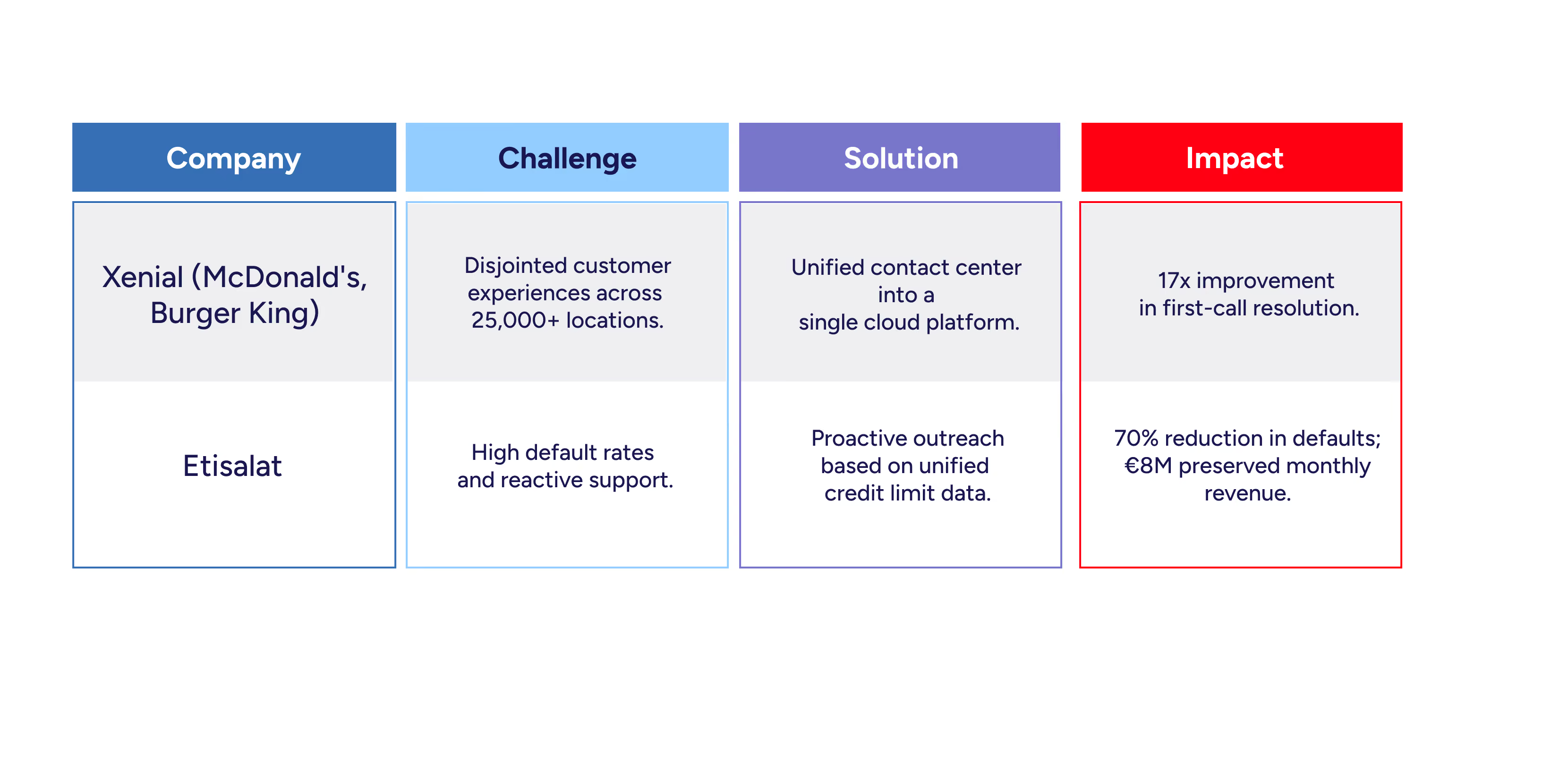
Evidence from the field
The examples below show how unified data can turn fragmented customer interactions into measurable business impact.
The pattern across these transformations is about finally seeing what customers have been trying to communicate all along.
How to measure whether a unified CX platform is working
Track the few metrics that reveal whether your connected customer view is reducing effort instead of just moving work around:
Repeat contact rate: Shows whether customers still need to come back for the same issue.
First-contact resolution: Measures whether the issue is resolved in the first interaction.
Customer effort score: Reveals how hard customers feel they have to work to get help.
Churn rate: Shows whether better visibility is improving retention.
Agent productivity: Measures whether agents resolve more cases with less manual searching.
Sentiment trend: Tracks whether customer tone improves or declines over time.
Why regional intelligence changes everything for Arabic-speaking markets
For organizations serving Arabic-speaking markets, the visibility challenge carries an additional dimension. Most global platforms treat Arabic as an afterthought, struggling with dialect variations and cultural nuance that determine whether a customer feels genuinely heard or merely processed.
Sentiment analysis that works beautifully in English often produces noise when applied to Arabic conversations. The difference between a customer expressing mild frustration and one at their breaking point can be entirely linguistic, embedded in dialectal expressions and contextual cues that generic AI models miss completely.
That becomes especially risky in WhatsApp-heavy support environments, where short voice notes, informal phrasing, and Gulf dialect expressions carry more meaning than literal translation suggests. A customer expressing resignation in Gulf dialect can register as neutral sentiment in a generic model, so your team misses the churn signal entirely. In markets where public social conversations and private messaging both shape trust, tools like Social Listening also need to understand Arabic sentiment at the dialect level and operate within regional data privacy expectations.
How Lucidya unifies customer experience across the Arab world
This is the visibility gap Lucidya was built to close. Lucidya's unified customer experience platform connects public signals, private conversations, feedback, and workflow actions into one operational layer designed for Arabic-speaking audiences.
The agent who could not see Sarah's previous contacts is the problem OmniServe solves with a unified inbox and cloud-based communication platform for omnichannel customer service. The shallow record that only shows a name and number is what Profiles fixes by building a true 360-degree customer profile from every interaction. The sentiment shift that happened three calls before cancellation is what Call Analytics surfaces across voice conversations. The missing feedback loop between support and the rest of your business is where Survey adds structure, linking direct feedback to unified customer data and broader service decisions.
When you need an AI-powered customer platform layer on top of that foundation, AI Agentworks alongside your teams across digital channels to resolve routine requests while preserving governance and control. Together, these products connect market visibility, support workflows, and interactions with customers into one system instead of a stack of disconnected tools. For regulated industries, Lucidya also supports enterprise requirements around Saudi PDPL, GDPR, and SOC2 compliance.
When your entire organization sees the complete customer journey, service becomes proactive, marketing becomes precise, and growth becomes sustainable.
The bottom line
Your call center's performance problems are probably not about speed. They're about sight.
Every unconnected system is a blind spot. Every interaction analyzed in isolation is a missed opportunity. Every agent operating without context is working harder than they should have to. The question for your organization isn't whether your call center customer experience is fast enough. It's whether it can see at all.
Ready to eliminate the blind spots in your customer operations? Request a demo and discover what unified customer experience reveals about your business.
Frequently asked questions
What is the difference between a unified CX platform and a CRM?
A CRM stores relationship and account data, primarily for sales. A unified customer experience platform connects that data with live conversations, support history, sentiment signals, and engagement channels so that service and marketing teams can act on a complete customer picture in real time.
How does a unified customer experience platform reduce customer support repetition?
It eliminates repetition by giving agents a single view of the customer's full history across every channel before the conversation begins. The agent sees previous emails, chats, calls, and social interactions, so the customer never needs to re-explain the situation.
What KPIs should I track after implementing a unified CX platform?
Track repeat contact rate, first-contact resolution, customer effort score, churn rate, agent productivity, and sentiment trend over time. Repeat contact rate is the most direct measure of whether customers are still having to re-explain their issues.
Is a unified CX platform the same as an omnichannel helpdesk?
No. An omnichannel helpdesk routes messages across channels. A unified CX platform connects those messages with customer profiles, sentiment data, and interaction history so that every agent has full context, not just the current message.
Why does Arabic language support matter in a unified CX platform?
Arabic sentiment and intent vary significantly across dialects. A platform trained on Modern Standard Arabic will misread colloquial expressions from customers in Saudi Arabia, Egypt, or the Gulf. Accurate sentiment detection requires dialect-level NLU, not just language translation.
How long does it take to see results from a unified CX platform?
Organizations typically see measurable improvements in repeat contact rate and first-contact resolution within the first quarter after deployment, especially when implementation starts with one high-volume channel such as WhatsApp or social support before expanding to voice and email.
Lucidya is an AI-native customer experience management platform built specifically for MENA markets. It combines social listening, omnichannel customer service, media monitoring, survey tools, and AI-powered analytics into one platform, with native support for 17 Arabic dialects and 92% sentiment analysis accuracy in both Arabic and English.
What channels does Lucidya connect for customer experience management?
Lucidya monitors and unifies data across six channel categories. Social media includes X (Twitter), Instagram, Facebook, YouTube, TikTok, and Snapchat public accounts via native ingestion and APIs. Media covers news sites, blogs, and forums through crawlers and APIs. Reviews are tracked through Google Reviews via API integration. Messaging channels include WhatsApp via official API integration, email via SMTP, and social DMs across platforms. Live chat is handled natively through OmniServe. Voice and call center data is ingested via API integration. Survey and website feedback is collected through Lucidya's native Survey product and embedded website scripts.
How accurate is Lucidya's Arabic sentiment analysis compared to other platforms?
Lucidya's sentiment analysis reaches 92% accuracy in both Arabic and English. Unlike Western platforms that require extensive customization for Arabic content, Lucidya's AI is built in-house and trained natively on 17 Arabic dialects (from Khaliji to Maghrebi) making it significantly more accurate for MENA markets than global alternatives like Brandwatch or Sprinklr. Lucidya's Arabic NLP engine supports 17 dialects across seven major dialect groups: Modern Standard Arabic (MSA), Saudi Arabic (Najdi, Hijazi, and other regional Saudi variations), Yemeni Arabic (including White/Yemeni dialect variations), Khaleeji Arabic (Emirati, Bahraini, and Kuwaiti dialects), Egyptian Arabic, Shami Arabic (Palestinian, Syrian, and Lebanese dialects), Maghrebi Arabic (Moroccan, Libyan, and Algerian dialects), and Iraqi Arabic.
How does Lucidya handle data privacy and compliance in Saudi Arabia and the MENA region?
Lucidya complies with Saudi PDPL, GDPR, SOC 2, ISO 27001, and SDAIA requirements. Data is encrypted, securely stored, and can be hosted regionally to meet local compliance needs across the Gulf.
What types of organizations use Lucidya?
Lucidya serves enterprise brands, government entities, and large regional organizations across Saudi Arabia and the broader MENA region. Key sectors include banking and financial services, government and public sector, travel and tourism, insurance, hospitality, logistics, and telecommunications. The platform is built for organizations that need Arabic-native AI at scale, not generic tools adapted for the region.
What products make up the Lucidya platform?
Lucidya is a suite of six integrated products. Social Listening monitors brand conversations, competitor activity, and emerging trends across social media channels in real time. OmniServe is an omnichannel inbox that unifies customer messages from social media, WhatsApp, email, and more into one AI-powered workspace. Profiles is a Customer Data Platform that builds 360° customer views by unifying behavioral, sentiment, and demographic data. Survey collects and analyzes customer feedback across channels with Arabic-native sentiment analysis for open-text responses. AI Agent automates customer interactions in Arabic and English across WhatsApp, social media, and other channels with support for 17 Arabic dialects. Media Monitoring tracks brand presence across online news, blogs, and broadcast media. All six products share the same Arabic-native AI engine and can be deployed together as a full CXM suite or individually based on business needs.
How does Lucidya differ from other enterprise CX platforms for MENA markets?
Most enterprise CX platforms are built for English-language markets and adapted for Arabic as an afterthought. Lucidya is built from the ground up for MENA, with in-house Arabic NLP trained natively on 17 dialects achieving 92% sentiment accuracy. The platform complies natively with Saudi PDPL and regional data residency requirements, offers local hosting options, and is designed specifically for the regulatory, linguistic, and cultural context of Gulf enterprise. This means MENA brands get accurate results without the customization costs and accuracy tradeoffs that come with adapting a global tool for the region.
Why do Western CX platforms struggle with Arabic markets?
Most Western CX platforms are built on AI models trained predominantly on English language data. When applied to Arabic, these models struggle with right-to-left script, dialect variation, and the significant differences between Modern Standard Arabic and the 17+ spoken dialects used across MENA. The result is inaccurate sentiment detection, missed context, and insights that don't reflect how Arabic speakers actually communicate. For brands operating in Saudi Arabia, the UAE, or broader MENA markets, this translates directly into poor decisions based on unreliable data.
Take the next step toward a smarter customer experience
Dive deeper with fresh perspectives for smarter CX

.svg)






.svg)




.svg)
























%20with%20competitive%20intelligence_640x774.avif)