.svg)



Marketing & Brand
What is Agentic CX and what does it change for marketing teams?
Explore how Agentic CX helps marketing teams use real-time intelligence to adapt journeys, personalize actions, and connect decisions to business outcomes.
Explore how Agentic CX helps marketing teams use real-time intelligence to adapt journeys, personalize actions, and connect decisions to business outcomes.


What if the biggest change AI brings to marketing is not faster content, better targeting, or more automation?
What if it changes what marketing is responsible for?
Most marketing teams already use AI to generate content, summarize insights, analyze performance, or recommend what to do next.
But BCG’s 2026 survey of 300 global CMOs found that while 96% believe AI is driving an end-to-end transformation of marketing, only 8% are running campaigns where multiple agents operate autonomously.
That gap explains how AI is improving individual tasks without necessarily changing how marketing operates.
Agentic CX goes further.
It allows AI to interpret customer context, decide what should happen next, and execute permitted actions within clear business rules.
For marketing teams, that changes four things most directly:
Agentic CX applies agentic AI to customer experience, allowing AI agents to interpret live context, make decisions within defined permissions, execute approved actions, and escalate situations that require human judgment.
The difference becomes clearer when compared with traditional automation:
→ Marketing automation follows predefined triggers and workflows.
→ Generative AI can create content, summarize research, or recommend a next step.
→ Agentic AI can determine what should happen next and execute that action within defined permissions.
McKinsey describes a similar shift in CX: from predefined journeys toward dynamic, cross-channel orchestration, where teams define objectives, guardrails, and escalation points while systems adapt to changing context.
The clearest way to understand Agentic CX vs traditional CX is to look at how context, journeys, and actions are handled. In marketing, that difference becomes especially clear when compared with traditional automation:
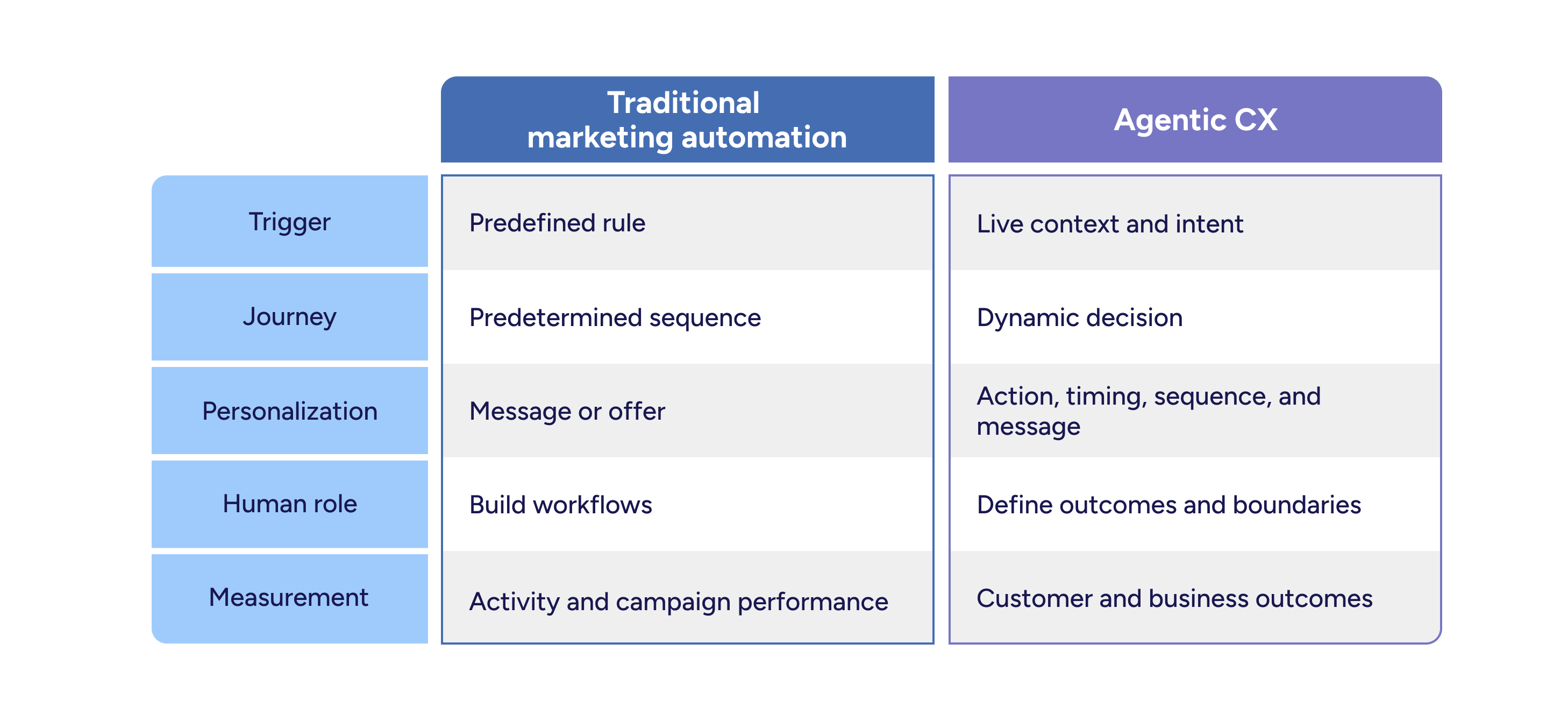
The shift is not about removing rules. Rules define what AI is allowed to do, when it can act, and when it must escalate.
From there, the impact on marketing becomes practical.
Marketing has spent years getting better at understanding customers.
Social listening detects sentiment shifts. CRM data shows declining engagement. Surveys reveal dissatisfaction. Support data exposes unresolved problems.
The traditional question is:
What does this signal tell us?
Agentic CX adds a more important one:
Can AI act on this signal within the rules we have defined?
At LEAP 2026, Lucidya Founder & CEO Abdullah Asiri described this distinction as the move from intelligence to outcomes: “Businesses are ultimately measured by what they deliver, not simply by what they understand.”
He used marketing as an example. An AI agent may draft campaign copy, while an outcome-focused agent can work toward a defined result such as generating and converting demand.
Watch Abdullah Asiri’s LEAP 2026 session on Agentic CX
The value is in reducing the time and cost required to move from signal to decision, action, and outcome.
This is one of the clearest examples of how agentic AI improves CX: it shortens the path between understanding what is happening and acting on it.
Traditional journey automation works from a predefined path: if X happens, trigger Y.
Agentic CX works from a live context. It can interpret what is happening now, select the appropriate next action, and execute it within defined permissions.
So if the customer’s situation changes, the journey can change with it.
This is the shift from journey automation to customer journey orchestration: the journey is still governed, but the next step is no longer locked in advance.
A simple way to describe the agentic loop is sense, decide, act, resolve: sense what has changed, decide the appropriate next step, act within defined permissions, and move the customer toward resolution or the intended outcome.
That also changes what AI-powered personalization means.
Personalization has traditionally optimized what the customer sees: the message, offer, recommendation, or channel.
Agentic CX can personalize what the business does next.
For one customer, that may be an offer.
For another, no action at all.
For another, resolving an issue before attempting to sell anything.
That is the difference between next-best message and next-best action.
In structured service workflows, Lucidya’s AI Agent applies this action layer by using customer context and approved enterprise tools to execute permitted actions and escalate exceptions when needed.
For marketers, the shift is significant: personalization is no longer only about making communications more relevant. It is about making the next action more relevant to the customer’s current situation.
Campaigns will remain central to marketing.
But Agentic CX expands marketing’s role beyond designing campaigns. It connects customer intelligence to business decisions, actions, and measurable outcomes.
With agentic AI for marketing, the question is no longer only whether a campaign performed. It is whether the actions taken helped improve the business outcome they were designed to influence.
That also changes how marketing demonstrates value.
As Yara Milbes, SVP Marketing and Growth at Lucidya, puts it:
“Marketing earns a seat at the table when it can speak the language of finance and operations, not just campaigns.”
Agentic CX makes that point more concrete.
If marketing influences retention, churn prevention, journey sequencing, service priorities, or loyalty, its impact cannot be described only through campaign metrics.
The conversation expands to outcomes such as retention, customer lifetime value, revenue, customer effort, resolution, cost, and loyalty.
This is why McKinsey argues that value from agentic AI for marketing comes from redesigning end-to-end workflows, not simply inserting agents into existing processes.
The customer sees one company. Internal systems often see fragments.
Marketing sees engagement. Service sees an open case. Social listening sees sentiment. CRM sees campaign eligibility.
That is how a customer with an unresolved complaint can still receive a retention offer.
Agentic CX helps prevent that by bringing customer signals into one decision context, rather than letting each system act on its own fragment.
The offer may be fine. The decision to send it is not.
For marketing teams, that means customer experience automation depends on more than automation technology. It requires shared customer intelligence, clear ownership, and aligned outcomes across marketing, CX, service, data, and operations.
Agentic CX does not mean giving an AI agent unlimited freedom.
Before automating a customer decision, teams should set five parameters:
For a deeper look at this governance layer, see Agentic AI Is Not About Intelligence. It’s About Control.
The best starting workflows also tend to share a few practical characteristics:
This reflects the framework Abdullah Asiri shared at LEAP 2026 for choosing where to start with outcome-driven AI agents.
For marketing teams, good starting points are workflows where customer signals can reliably trigger a defined, governed action, such as:
A poor starting point is a highly ambiguous decision with incomplete data and an action that is difficult to undo.
For a practical look at how governed agents move from conversation to action, Lucidya’s webinar on autonomous resolution explores how AI agents can apply policies, use enterprise data, and execute resolutions across systems.
For MENA organizations, the quality of customer intelligence is also a linguistic issue.
Intent, dissatisfaction, urgency, humor, and sentiment can be expressed differently across Arabic dialects.
If these signals feed customer journey orchestration, personalization, churn interventions, or autonomous actions, misunderstanding the language can affect the decision that follows.
Arabic-native intelligence therefore becomes part of the foundation. Lucidya’s Social Listening is built to analyze Arabic conversations across regional dialects, while Lucidya and Frost & Sullivan’s report, AI-Native CXM for the Arabic-Speaking World, explores the broader implications of Arabic-first AI, connected customer data, and regional governance.
For agentic workflows, the implication is direct:
Agentic AI in CX can only act as well as it understands the customer.
Do not measure Agentic CX by how much work was automated.
Measure whether customer and business outcomes improved.
Ultimately, how AI improves customer experience should be visible in the outcome, not in the volume of automation.
.png)
More automation does not automatically mean more value.
A retention workflow can trigger more offers without reducing churn. A service workflow can close cases faster while repeat contact rises.
The metric should follow the outcome, not the automation.
For teams asking how to use AI to improve customer experience, the starting point is not to automate everything. Start with one business decision or workflow that is too slow, too fragmented, or made without enough context.
Define:
Then test the workflow.
Expand autonomy only when the result improves.
Agentic AI for marketing is not about automating more marketing activity. It is about shortening the path from intelligence to business outcome.
Agentic CX applies agentic AI to customer experience, allowing AI agents to interpret customer context, make decisions within defined permissions, execute approved actions, and escalate when human judgment is required.
Agentic CX vs traditional CX comes down largely to how decisions and actions are handled. Traditional CX processes often depend on predefined workflows and manual handoffs, while Agentic CX can use changing context to select and execute permitted actions within defined governance.
Agentic AI for marketing refers to AI agents that can perform or coordinate multistep marketing work and make permitted decisions based on goals and customer context, rather than only generating content or following predefined rules.
It allows the next action to adapt to live context such as intent, sentiment, customer behavior, journey stage, and unresolved issues instead of relying entirely on predefined sequences.
Sense, decide, act, resolve describes how an agentic system can interpret customer signals, determine the appropriate next step, execute a permitted action, and work toward a defined resolution or outcome.
One way to understand how AI can improve customer experience is to look beyond content generation and recommendations. With Agentic CX, AI can interpret customer context, select a permitted next action, execute it, and escalate when human judgment is needed.
No. It shifts more routine execution to AI while marketers remain responsible for strategy, customer understanding, brand judgment, objectives, guardrails, and business outcomes.


.svg)


.svg)






















%20with%20competitive%20intelligence_640x774.avif)